The Complete Guide to Multi-Provider Waterfall Email Enrichment
How modern outbound teams lift B2B match rates from ~45% to 80%+ while keeping hard bounce rates under 2%—without maintaining five separate vendor contracts or $149/mo spreadsheet seats.
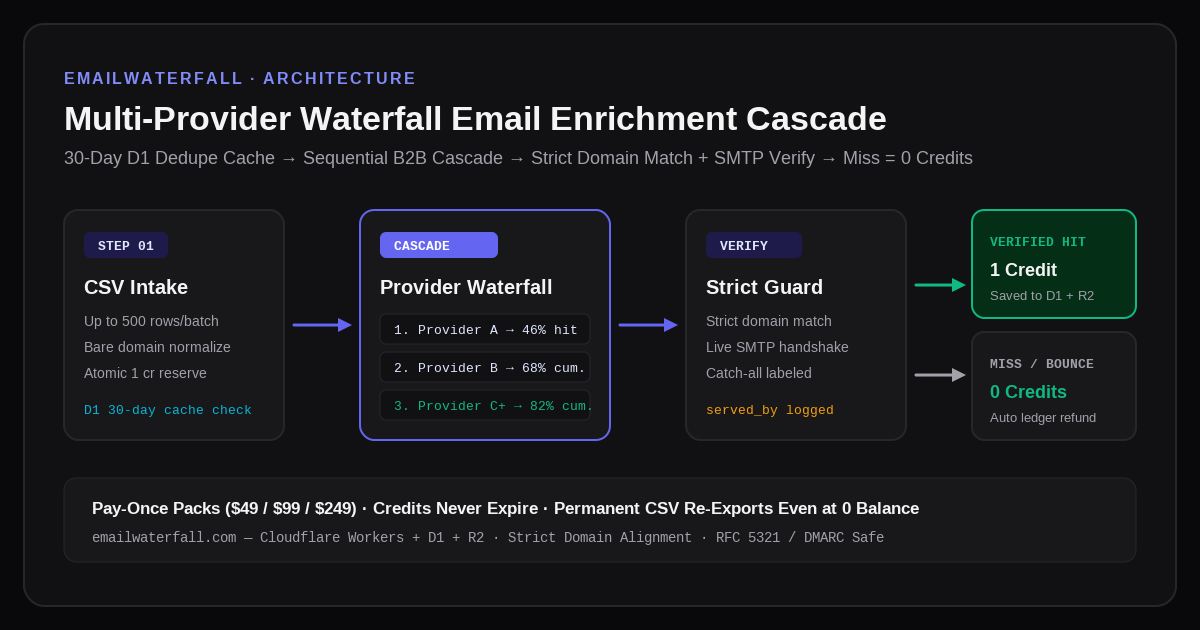
1. Why Single-Provider Databases Leave 40% of Your ICP Behind
No single B2B contact database has uniform coverage across industries, company sizes, and geographies. One vendor excels at US venture-backed SaaS, another specializes in European SMBs, and a third resolves recent executive job changes fastest.
When you export 500 prospects from Sales Navigator and query a single tool like Prospeo or Apollo alone, you typically walk away with 210–250 deliverable emails. A multi-provider waterfall automatically routes the remaining 250 misses down a prioritized chain—stopping immediately on the first verified hit—lifting cumulative coverage to 380–425 verified contacts while refunding exhausted misses back to 0 credits.
2. CSV Hygiene Checklist Before Running Any Waterfall
- Normalize company domains: Strip
https://,www., and tracking paths using our free CSV Lead Cleaner. - Strip shared role inboxes & deduplicate rows: Remove
info@,sales@, and duplicate prospect entries before spending credits (EmailWaterfall also enforces a 30-day D1 deduplication cache across batches). - Include LinkedIn URLs when available: Disambiguates common names at large enterprises and boosts strict domain-match accuracy across waterfall providers.
- Batch into 500-row segments: Use our CSV Domain Splitter to partition large TAM exports into inbox-safe sequencer slices or company-domain ABM pods.
3. Strict Domain Matching, SMTP Verification & Catch-All Routing
EmailWaterfall enforces three guardrails on every row: strict domain matching (rejecting stale former-company addresses and personal webmail), real-time RFC 5321 SMTP verification (filtering 550 hard bounces before you ever pay a credit), and explicit deliverability labels (verified, catch_all, not_found).
Operational rule for catch-all verification: Enterprise mail gateways (especially Microsoft 365 and Proofpoint deployments) frequently answer 250 OK for any local part. Never mix unverified catch-alls into your primary executive domain pool—export verified rows into your flagship SPF/DKIM/DMARC-aligned inboxes, and test catch_all rows separately at conservative daily send caps.
4. Waterfall Stack Economics: Clay vs BetterContact vs FullEnrich vs EmailWaterfall
Before committing budget, compare true cost per verified, domain-matched email over 12 months—not just headline monthly credits:
- Clay ($149/mo+): Powerful general GTM spreadsheet when you employ a dedicated RevOps engineer, but $1,788/year minimum with monthly rollover limits and manual waterfall setup.
- FullEnrich & BetterContact: Dedicated waterfall aggregators, yet unused credits depend on maintaining a recurring monthly subscription.
- Single-Provider Tools (Prospeo / Apollo): Fast first pass, but leaving 45–55% of leads unfound forces multi-vendor CSV stitching.
- EmailWaterfall ($49 / $99 / $249 one-time): Flat 1 credit per verified hit ($0.123 → $0.099 → $0.083), automatic 0-credit ledger refunds on misses, never-expiring balances, per-row
served_byattribution, and permanent R2 CSV archives.
Recommended Next Steps in Your Waterfall Workflow
Troubleshoot Low CSV Match Rates
Fix URL domains, Inc./LLC suffixes, UTF-8 BOM headers, duplicates, and catch-all rows before uploading.
Run a Waterfall Without Clay ($149/mo)
See the exact zero-subscription CSV workflow, what is free vs paid, and when Clay is still the better fit.
Run Free CSV Lead Cleaner
Deduplicate leads, normalize bare domains, and strip role emails locally in your browser at $0.
Technical FAQ
What is waterfall email enrichment?
Waterfall email enrichment queries multiple B2B email data providers sequentially—stopping as soon as a verified, domain-matched email is returned. Instead of accepting a 40–50% single-database match rate, waterfalls routinely recover 75–85%+ of target B2B contacts.
Why does strict domain matching matter for cold outbound?
Loose enrichment tools frequently return an outdated email from a prospect’s previous employer or a personal Gmail address. Strict domain matching enforces that the returned email matches the exact target company domain in your CSV.
How should RevOps teams handle catch-all domains?
Catch-all (accept-all) mail servers report every address as syntactically accepted during SMTP handshakes. EmailWaterfall labels catch-all rows clearly so you can route verified rows to primary domains and isolate catch-alls into separate warmed inboxes.
How does pay-only-on-verified-hit pricing differ from Clay, BetterContact, or Prospeo?
Single-provider databases like Prospeo leave half your list empty, while Clay ($149/mo) and subscription waterfalls like BetterContact or FullEnrich bind unused credits to monthly renewals. EmailWaterfall charges flat 1 credit per verified hit on permanent packs ($49–$249) and automatically refunds misses to 0 credits.
Technical Standards & Compliance References
- IETF RFC 5321 — Simple Mail Transfer Protocol (SMTP)
Authoritative SMTP specification defining RCPT TO verification handshakes, 550 hard-bounce responses, and accept-all mail server behavior.
- IETF RFC 5322 — Internet Message Format
Defines canonical email address formatting and header hygiene standards validated prior to enrichment.
- IETF RFC 7208 (SPF) & RFC 7489 (DMARC)
Email authentication specifications explaining why keeping hard bounce rates under 2% protects outbound domain placement.
- FTC CAN-SPAM Act Compliance Guide for Business
Federal commercial email standards covering transparent sender headers and timely opt-out suppression.